
Finding Nobody in Indiana
An Essay
ABOUT THE WRITER
Michael Templeton is a writer and an accidental nomad poet. After years of wandering in the academy, and more years of wandering in the kitchen, he now lives and works in the Middle of Nowhere, Ohio. He writes books, apoems, essays, experimental essays, and plays. He also works as a freelance writer, mostly for non-profits. You can access his personal blog Templeton Didelphis here.
You can download a digital copy of his book the awaiting of awaiting here.
Richmond, Indiana is unremarkable in all the ways you would expect it to be unremarkable. It is a nothing town in the American Midwest, a region long ago relegated to the amorphous unknown spaces to be flown over, driven through, or summarily forgotten as easily as possible. Nothing about this little city or the state in which it is situated would or could grab anyone’s attention from beyond the State of Indiana. It is precisely in its invisibility that Richmond comes to be something other than its enforced nothingness. If you pay attention, you can see a microcosm of contemporary America in Richmond. Gentrification has not quite gotten a claw in the town, but they are trying. I’ll get to that. In so many other ways, Richmond embodies and dramatizes contemporary American life. On its own, it is mute. The town speaks nothing about itself. There is no visible town square as the only vestiges of real activity have moved from the town proper to the outskirts where the eight lane boulevard runs out of town toward the interstate. Here you find all the big box retail and chain restaurants, the super-service stations, and the billboards directing you to more of the same. Everything here is designed for the automobile, and any signs of human life in the form of a human body takes place in parking lots that are four times the size of the retail and dining spaces they are meant to serve. This is the space that accommodates a form of everyday life Debord could only dream of when he said that “(e)veryday life, policed and mystified by every means, is a sort of reservation for the good natives who keep modern society running without understanding it — this society with its rapid growth of technological powers and the forced expansion of its market. History (the transformation of reality) cannot presently be used in everyday life because the people who live that everyday life are the product of a history over which they have no control. It is of course they themselves who make this history, but they do not make it freely or consciously” (“Perspectives for Conscious Changes in Everyday Life”). The people who make this spectacle work are all invisible even to each other. Those who traverse the terrain of modern consumerism are hidden within their automobiles and cover the roads in as little time as possible. All space exists solely to be overcome. Those who make whatever they can out of the global corporate giants who own everything are hidden behind walls or become visible only in uniforms that function to efface identity and replace it with the same endlessly substitutable uniformity that defines every other commodity for sale along this corridor of pure emptiness. Anything visible is infinitely replaceable, and therefore does not truly exist. There is no everyday life here because there is no history here. If the rudiments of a history begin to coalesce, they are immediately erased. Both the people and the micro-events of a crisis which could become an emergent historical event are swept away as quickly as possible, all for the sake of safety, efficiency, and to optimize customer experience.
We make our way up the main road off the highway. Past the restaurants and big chain retailer, past the Dollar General and Pilot service station… traffic flies back and forth. Noise. Impatience—both mine and everyone around me. I become a part of the system and the problem as quickly as I enter it. The more we head down this road, the more narrow it becomes, slimming from eight to four lanes. The billboards and signs change imperceptibly. By the interstate, everything directed us to more food and more places to go for gas. Signs for the odd motel are staggered to maximize information. Further in, the signs are meant for the people who live here. Discount mattress stores, tattoos, wigs, and drug treatment programs. Signs for drug treatment increase in number the more we travel into the town of Richmond. We soon begin to see apartment complexes and mobile home parks. The signs by the road are worn, some are missing letters. Everything is in some state of obvious decay. Pedestrian traffic increases, and we soon enter the town proper. Houses line the road. Some still show the façade of their former glory days, back during a time when there was some kind of local economy to generate local wealth. With that gone, the old mansions of this part of town are abandoned and left to rot. We can see evidence that people are working on an old house here and there, but most are boarded up and falling apart. Drug treatment programs advertise on the backs of the benches at bus stops, and people mill around those same stops smoking and talking on cell phones. The road slims down to two lanes, and begins to meander a little as the old layout of the town interrupts the fluidity of contemporary automobile flow.
Everyday life takes place in those broken down houses, apartment complexes, and mobile home parks. These are the places wedged in between the void of the consumerist spectacular hell that leads to the void of the interstate, and an urban no place where no one lives and no one even so much as appears on the street. These kinds of places make certain that nothing ever emerges into history. Humans are held in thrall to a far-off nothing that exists purely in a digital dream, or they are anesthetizing their despair in drugs both legal and illegal, or they are occupying the faceless nameless positions of anonymity and replaceability in the consumerist corridor of the eight lane boulevards. Everyday life is that there is no everyday life. They are all shut into what amounts to camps, enclosures for the nobodies. Sticking up from houses, trucks, and cars we see the Trump signs and American flags. These people are so lost from the world they have placed all their faith in a tv show version of America that will magically restore everything to a golden age when something was better—anything was better. They do not know.
We reach the part of Richmond that has the appearance of the downtown area. There are larger buildings, the kind of architecture that take up the better part of a city block. We can see that things are laid out in the manner of an urban grid. We park and begin walking around. It is clear that the big money folks and the town leaders are working hard to remake Richmond, Indiana for the 21st Century. Nearly all buildings are empty. Almost everything is vacant, and many of the vacant buildings have rehab construction going on inside and out. Nearly all exteriors have been scrubbed clean of graffiti and tags. Even signs have been reduced to a minimum. Mostly just street signs. The entire urban center is almost completely empty. No one in sight in any direction. We walk up the main road. The former beauty of the town is visible. The names built into early 20th century structures are still clearly visible in the old stone settings at the top of buildings, built at a time when the ideas of permanence and forever were still viable ways of thinking, when “Great Men” built the west and furthered the Grand March of Progress. But all of these buildings are completely empty, and nearly all of them advertise for businesses and individuals to lease space in the new rehabbed glory of the old Richmond. The emptiness and desolate space of the urban core, along with the vacuous exterior near the interstate, all speak to a world composed of lives that are always elsewhere no matter where they are. At home, on screens, finding the life that is also elsewhere in the network of webs that capture humanity and separate it from lived life, from everyday life.
The people are absent because, like people everywhere in the 21st Century, they are captured by the online presence of a life that is forever elsewhere, receding into an absence where it always was. The people exist only in the reticular society of the online representation of life, that online spectacle which renders the society of the spectacle in its most staggering form. The absence of humanity is “the networked presence of the life it makes absent” (Ian Alan Paul. The Reticular Society, 5). What takes place on the streets is simply the outward expression of an absence that is the online transformation of everyday life into the complete absence of all life. There is no one to be seen because even those who would otherwise exist have already given themselves over to the digital void which is contemporary life. Any emergence of life, of lived life, is instantly swept away just like the crises that occasionally emerge on the eight lane boulevards of consumerism. If a human makes their way down the streets of downtown Richmond, it is almost certainly because some form of despair and real destitution has forced them out of the digital reticular society that enables them to physically disappear in the designated spaces of contemporary economic life where they can be properly disguised and made uniform and imperceptible. The people are in the broken-down homes between here and the interstate. Visible humanity is a crisis, an accident, something that is utterly intolerable for the reticular society. Everything must now be situated in accordance with the accumulation and circulation of life as data. There is no life where there is no data; where there is no data, there is no life. In this way, the visible absence on the streets of Richmond is the economic ideal form of everyday life as it is “pixelated” into “a newly and more densely mediated society where living, having, and appearing are all subsumed within economies of digital abstraction and circulation” (25). There is no need of living human bodies circulating on the streets since lived life takes place in a digital space of mediation wherein life is perfectly aligned with its data-fied form and can be circulated and exchanged in a space of ideal perfection.
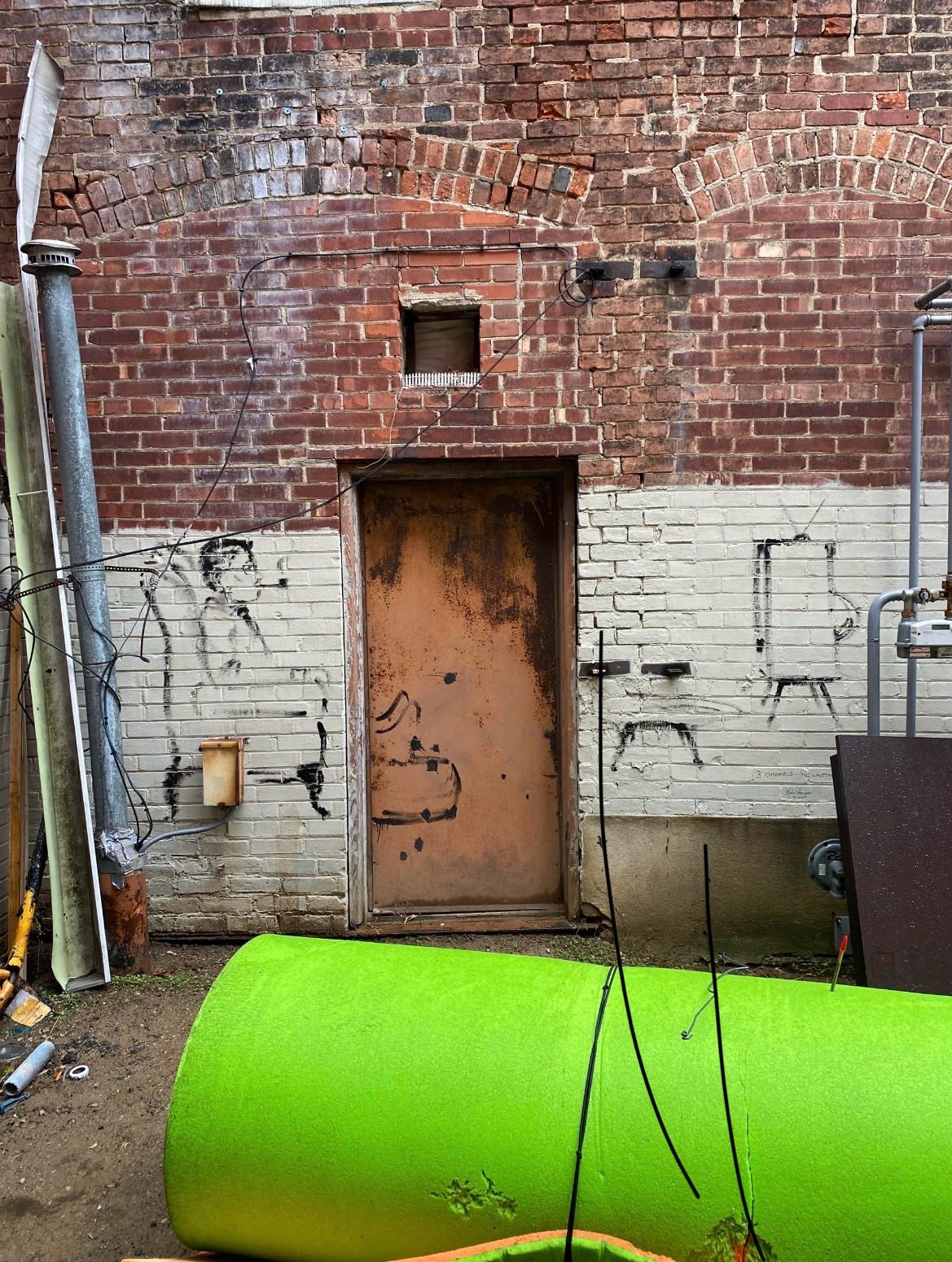
Making our way around the streets and down alleyways there were some curious surprises still to be found. While taking a photo of some unremarkable graffiti, I ran into a woman taking trash out to a dumpster outside one of the buildings being rehabbed. I asked her about all that was going on in town. She looked shocked that I spoke to her. She looked worn down. I know nothing about the woman, but she had the appearance of the people I met in drug treatment. Her body was worn down, sickly rail-thin, toothless, her skin a pallid gray. She told me she missed the fountains that use to run in the middle divider of all the roads. Those were gone, it seemed. She also said “they” (that mystical “they” that knows things and does things) were trying to rebuild the city—bring it back.
We also found an alley that had clearly defied the official image machine of downtown Richmond. While the city had obviously begun the process of adorning the urban center with murals and images that depict the official self-image of the town of Richmond, one lone artist had begun their own project on the walls of one of the few spaces that had escaped the antiseptic drives of the modern city-machine. A series of small paintings, in a single color, spilled out from a narrow alley that was choked with litter. Some of the paintings were taken from commonly known images. The young woman grieving over the death of her friend at Kent State, for instance. Others were more obscure. There was a kind of medieval tapestry of imagery that began deep in the recesses of the alley and spilled out along the wall on the street that lined the alley. These things were clearly not part of the civic renewal at work in Richmond, Indiana. Someone had anonymously tapped into something and left their work for anyone to take in however they saw to see it. An anonymous artist managed to leave behind a formal remnant of life. It will almost certainly disappear once the officials find out about it. But for a short time, history emerged in the new improved Richmond, Indiana. Someone from the anonymous nobodies who are hidden behind uniforms, walls, and the reticular society that would allow them to disappear once and forever—a someone from the nobodies fully emerged into a presence, and they painted it on the wall. It took a criminal nobody to signify our absence. Someone from that rabble who fall out from drugs and despair and still remain alive, visible, real, and in whatever remains of everyday life. The ubiquitous they that know things and do things are perhaps what the Invisible Committee mean when they use the term “THEY” in place of Empire. The global network of capital that seeks to erase us all and render us nothing but passable consumers of everything, even ourselves, but which can never completely grasp and control everyone. The anonymous artist is one of the army of criminals and invalidated “abnormals” who continue to hatch the conspiracy of living bodies that scares the shit out of the Imperial THEY. It is us who launch a
Conspiracy of bodies. Not critical minds, but critical
Corporealities. That’s what Empire is scared of.
That’s what’s slowly coming about,
With the increasing flow
Of social defection.
(The Invisible Committee. Introduction to Civil War, 218)
I do not know, but I’d like to think so. Speaking only as one of “the strays, the poor, the prisoners, the thieves, the criminals, the crazy, the perverts, the corrupted, the overly alive, the overflowing, the rebellious corporalities”—speaking as one of the nobodies, I like to believe we still exist, even if unofficially. And unofficially is how we pose a threat. Destitution does not require permission or economic validity. Anonymity and silence are the weapons of our age, and it remains in the in-between spaces of decay where these weapons will be discharged.
Debord, Guy. “Perspectives for Conscious Changes in Everyday Life.” From The Bureau of Public Secrets.
https://www.bopsecrets.org/index.shtml
Paul, Ian Alan. The Reticular Society.
https://www.thereticularsociety.net
Tiqqun. Introduction to Civil War. Tr. Alexander R. Galloway & Jason E. Smith. Cambridge: Semiotext(e) Intervention Series 4, 2010.